

Ella Harry | Head Editor
May 26, 2026
As “Club Chalamet,” 59 year old Timothee Chalamet super-fan Simone Cromer has garnered support from thousands of fellow fans across the globe for running the notorious fan account. Her dedicated support of the actor, which, at times, many feel went much too far, has been a constant in his career since she began the Club Chalamet account in 2018 on X, previously known as Twitter. In 2023, Cromer skyrocketed to virality following her outrage at the news that Timothee Chalamet had begun to date Kylie Jenner. Since then, Club Chalamet has been a near-constant figure in pop culture and one of the more popular internet memes. Her role as “the” superfan of the celebrity has therefore made her sort of a celebrity herself with her work on the Club Chalamet account gaining her interviews with the likes of the Wall Street Journal.
With her consistent support of the actor spanning nearly the entirety of the past decade, the news that she posted to her social media over the weekend that she will be, for the most part, halting posting activity on her Club Chalamet accounts comes as a shock to many who have become familiar with Cromer’s online presence. Senior Cole Wilkes said that he “finds it so weird how easily Club Chalamet was able to detach from the account after so long. It’s really parasocial.” With Cromer effectively shutting down Club Chalamet, at least for the time being, it feels fitting to engage in a larger conversation surrounding relationships constructed online between the general public and personalities, whether influencers or celebrities.
The existence of a forum through which virtually anyone can follow another individual’s life and create content to the extent that the Club Chalamet has, if they so choose, has made engaging in parasocial behaviors increasingly accessible. While it has become normalized to follow the lives of celebrities more closely than it ever was in previous generations, taking a step back to acknowledge truly how much information the general public has access to is sobering.
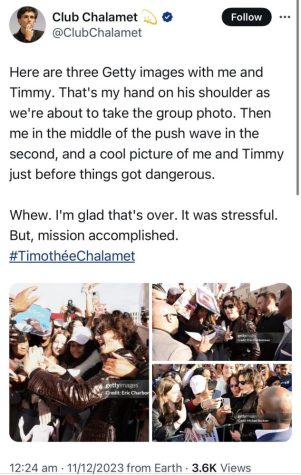
Rather than simply being dished small pieces of tabloid gossip via magazines once a month, individuals now have the ability to follow the lives of online personalities through social media, whether the celebrity wants them to or not. Relationships have become progressively more difficult for celebrities to keep private, and the backlash faced by many famous individuals’ fanbases following the mention of any sort of romantic connection is unnatural as a whole. Senior Nicole Valdez reflected on this phenomenon by emphasizing how “it isn’t just Club Chalamet. Similar things have happened with a lot of celebrities, like Korean fan pages that will hate on the partners of K-Pop idols.”
In a perfect world in which everyone was naturally inclined to respect the privacy of others and keep to themselves, the access that social media and the internet as a whole provide into the lives of other people would not be such a cause for concern. In today’s society however, the need that many feel to constantly be updated as to the lives of others and live vicariously through them prevents the continuation of the sense of normalcy to which previous generations were accustomed.
While Club Chalamet’s antics on social media have made many laugh over the past several years, her transition away from the account prompts a broader conversation as to what should be considered the norm in terms of following the lives of others online. Even though everyone with a phone has access to nearly every aspect of the lives of others, specifically celebrities, is it ethical to strip an individual of their right to privacy?

Leave a Reply