
Carson Neuhausen | News Editor
April 5, 2026
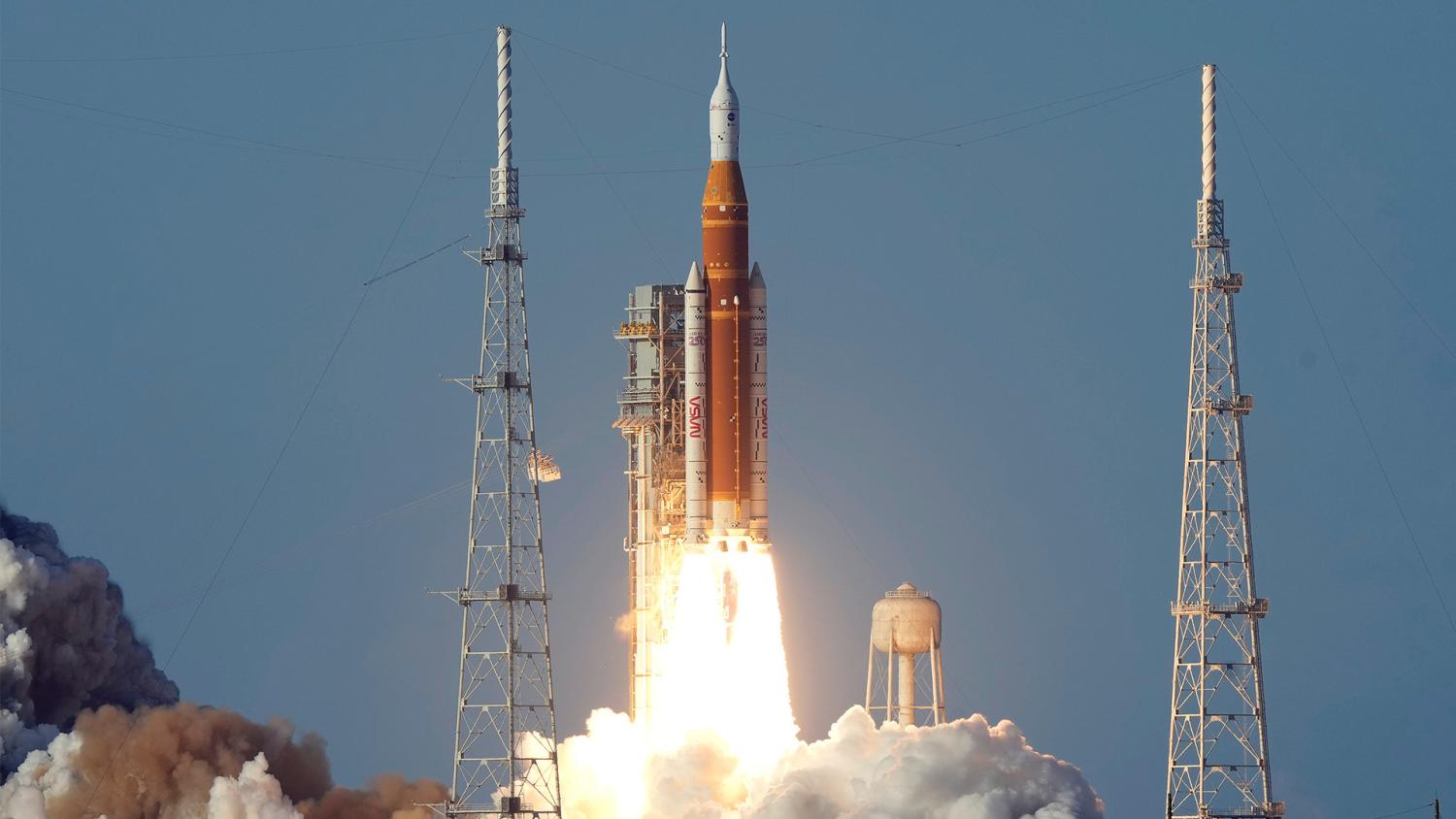
On Wednesday, April 1, 2026, the second iteration of the Artemis mission launched from Kennedy Space Center on Merritt Island, Florida. This expedition will be the first time since 1972 that humans will enter a lunar orbit. Additionally, Artemis II will be the first crewed test of the Space Launch System (SLS). The SLS is scheduled to be utilized for all future Artemis missions, including Artemis IV, which will land Astronauts on the south pole of the Moon.
Upon engine start, the SLS became the most powerful manned vehicle in human history at roughly 8.8 million pounds of thrust. Ignition began with the four core-stage engines at T-7, followed soon by the solid rocket boosters at T-0. The solid-fuel boosters did most of the heavy lifting as they pushed the Orion crew capsule through Earth’s heavy atmosphere. Once the rocket cleared the launch tower, a programmed roll commenced to align it with the correct trajectory for a high Earth orbit. SCHS junior Julian Duzman recalled the launch as he “watched it live on YouTube. It was the first rocket launch [he] had ever seen, and [he] liked how the broadcast tapped into the control communications so [he] could understand what was happening.”
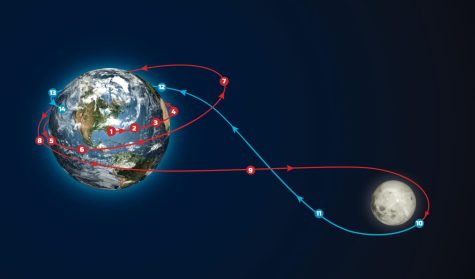
Artemis II is planned as a 10-day mission in which four Astronauts (3 American and 1 Canadian) will go farther than any human has since Apollo 17 (1972). Shortly after launch, the crew will enter an orbit around the Earth where they will test the docking systems and cross-station signal for future Artemis missions. Once these tests are complete, Pilot Victor Glover will oversee a translunar injection burn that will send the Orion spacecraft into a very specific orbit about the Moon. This precision is crucial because the crew will depend on a “free-return trajectory,” which is a complicated way of saying “let gravity do its thing.” If the burn is executed correctly, the Astronauts will slingshot around the far side of the moon, sending them straight back into low Earth Orbit. When informing SCHS senior Jack Blaney about the mission and its planned route, he told me that “[he] didn’t even know something like that was possible. It’s cool how we can just calculate the perfect orbit for them to return home safely using gravity.”
Throughout the mission, the crew will test critical systems, including life support and manual spacecraft control. These evaluations will be crucial in the future because they are the most reliable data points from the environment in which the Orion craft is intended to operate. Alongside those tests, the craft’s extremely high-speed reentry into the atmosphere and the information NASA gathers from it will help make future space missions significantly safer.
With that said, it is important that Artemis II is still simply a test flight. It serves as the bridge between the unmanned Artemis I and the complex Artemis III & IV missions. By safely completing the trip, NASA will have proven that it is possible to reach the moon with new technology despite the regulations and cautionary measures in today’s space age.
Leave a Reply