
Sedona Sweginnis | Newsroom Manager & Head Editor
November 14, 2025
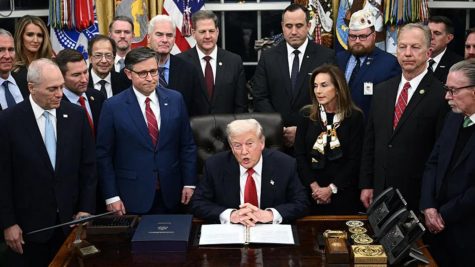
After 43 days, the longest government shutdown in American history has finally come to a close with the stroke of a pen late Wednesday night, November 12th. Nearly 1.5 million federal employees went without pay or work and it wreaked havoc in the United States. President Trump signed a bill that had been narrowly passed by Congress in a close 222 to 209 final vote, officially ending the shutdown, but still many pressing issues were left unresolved.
While it is most definitely a step in the right direction to get the government moving and performing once again, the bill only funds the government until January 30, 2026. The bill offers a breath of relief to those without work or pay during the prolonged budget disagreements, however its relatively short span of funding raises concern of whether a similar shutdown will ensue after the temporary funding ends with the month of January.
Many Americans feel strongly about certain sides of the argument regarding the budget, believing that certain expenses are not up for debate or compromise. However, as the shutdown dragged on to become the longest shutdown ever to plague the U.S., surpassing President Trump’s 2018-2019 35-day shutdown, Americans became increasingly anxious for a compromise to be reached through humility and collaboration regarding the budget so that the government could return to its usual functions and pay its workers.
Inexcusably numerous employees who serve our nation daily went without work or pay for far too long. Although eager to return to work and thankful for the opportunity to do so, many families wait patiently for back-pay to come for those vital personnel who continued to work without pay through the shutdown. Junior Addison Carey, whose parents are both government employees, explained that “having the government shut down was a time of confusion” for her family. She described that her father, a dedicated “active duty Marine, worked 10-hour days with no pay” in order to continue serving his nation even in a period of uncertainty and anxiety. Furthermore, Carey’s mother, one of the nearly 750,000 furloughed federal employees, “never knew exactly when she would go back to work,” making Carey extremely thankful and “glad now that it’s over and [that they] can all go back to normal.”
Between the half of the roughly 1.5 million employees without any work and the other half working but without pay, the majority of all federal employees are grateful that Congress was finally able to collaborate enough to pass a bill allowing for back-pay and return to work. Sophomore Avery Hart expressed this sentiment as her father is also in the military. Hart explained that the shutdown “did not affect [her family] personally, but [they] were concerned about not getting paid,” leading them to be extremely “thankful that it’s over.”
America is thankful to see its federal employees returning to work and the government running again. Although, there are concerns over the message that was sent to the international community about the government’s inability to compromise on a budget to the point of complete government shutdown are prevalent, as are uncertainties regarding the impending expiration of funds from the current bill at the end of January. We can always hope that this bill will end the period of turmoil and uncertainty and that it will usher in an era of compromise and maturity in politics.
Leave a Reply