
Ella Harry | Head Editor
February 12, 2026
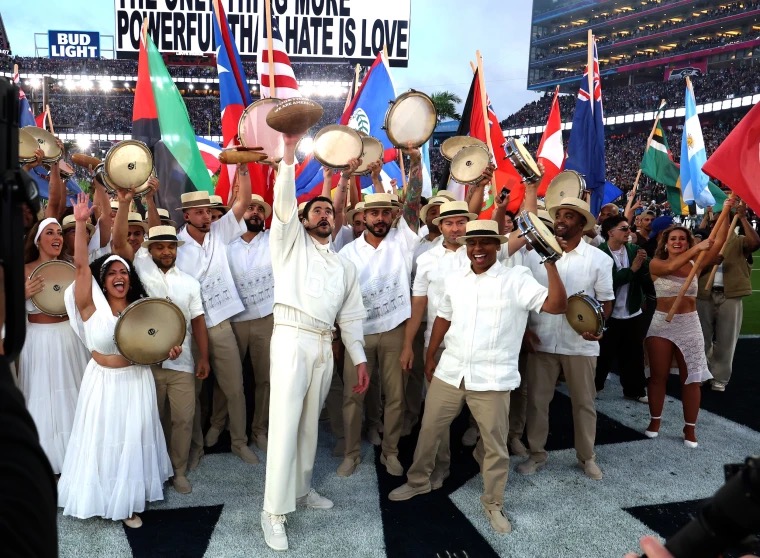
Following Bad Bunny’s performance at Super Bowl LX this past Sunday, there has been much outrage online over the NFL’s selection of an artist who primarily sings in Spanish. Such an uproar led not only to the creation of an alternative Turning Point halftime show, but to a flood of hate online for the artist, critiquing his music, his character, and even, in extreme cases, insinuating that he is “not American.” It seems as though, during this wave of extreme nationalism aimed at destabilizing multiculturalistic ideas, many on social media have forgotten the skill of employing empathy, as well as the basic, yet essential, knowledge that Puerto Rico is a US territory and its residents are US citizens.
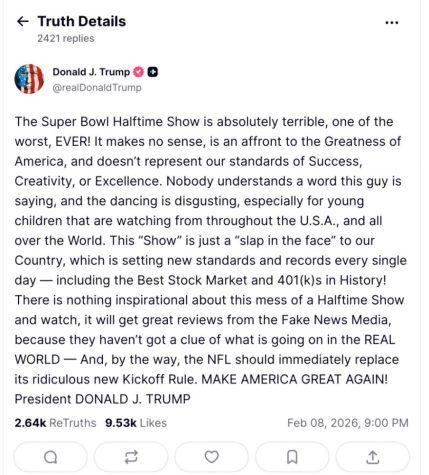
In a political climate where the phrase “the only thing stronger than hate is love” is viewed as provoking by many, with even the president commenting that the performance was “an affront to the Greatness of America” and a “slap in the face to our country,” it is undeniable that we are in the midst of a cultural war. While such tensions were put on full display this past weekend, the reluctance of many to engage with perspectives perceived as “foreign” has long shaped American conversations surrounding culture.
As South Korean filmmaker Bong Joon Ho expressed after winning an Oscar in 2020 for his film Parasite, “once you overcome the one inch tall barrier of subtitles, you will be introduced to so many more amazing films.” Such a statement applies to virtually all areas of media, whether film, literature, or music. In an era where insights into nearly every culture on the planet are readily available to American fingertips, intentionally choosing not to take advantage of such resources perpetuates ignorance. Such an unwillingness to interact with “non-American” perspectives has begun to be treated as a strength, when in reality, it is the ultimate weakness.
An inability to understand one’s neighbor, whether down the street, or a metaphorical one across the world, reflects a conscious choice to remain wholly consumed by one’s own perspective. Senior Avalon Davis highlighted this idea by sharing her opinion that “it has never been more important to pay attention to what’s going on in the world. So many Americans have become focused on only American perspectives, but there is so much more outside of that.”
In reality, the issue has existed far longer and expands far beyond Bad Bunny’s halftime show. Multiculturalism is pivotal to the US as a nation, and pretending as though all Americans should look a certain way, follow rigid cultural traditions, or speak only one language is a disingenuous, un-American ideal. Myla Pert, a senior at SCHS, expressed this sentiment and shared that even though, “[she] doesn’t listen to Bad Bunny’s music personally, it was a great way to celebrate different cultures within our country, especially with what is going on at the moment.” After all, if we have lost our ability to respect fellow Americans, whether it be Puerto Rican or Californian, can we really consider ourselves the “home of the free?”

Leave a Reply